
Modelling a Box Culvert in Prokon SUMO

Introduction A box culvert is a reinforced concrete structure commonly used to convey water beneath roads, railways, or embankments. It consists of a rigid rectangular frame formed by: Key Applications Box culverts are widely used in: Modelling Overview in Prokon SUMO In Prokon SUMO modelling involves: This guide outlines a structured workflow for accurate modelling […]
Curved Roof Truss Modelling in Prokon SUMO
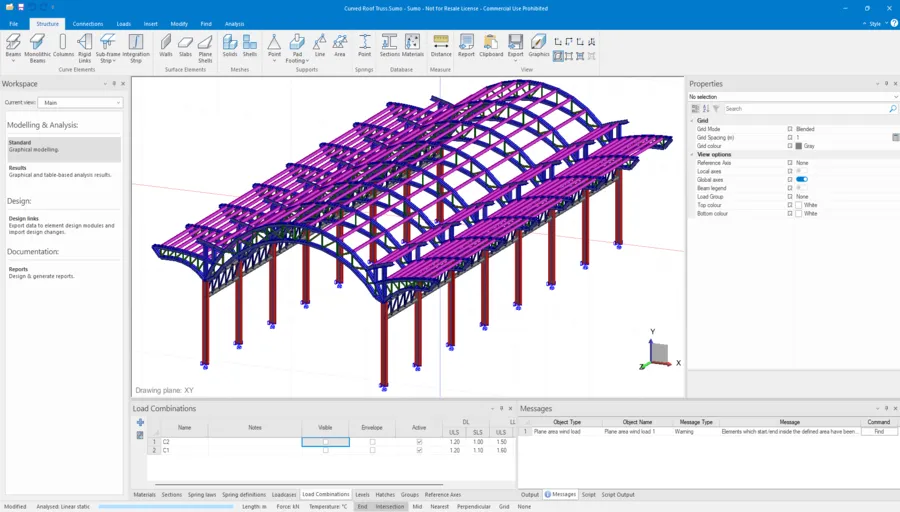
Curved Roof trusses are engineered structural frameworks with an arched or bowed top chord, designed to support curved, barrel-vaulted, or unconventional roof profiles Curved roof trusses are widely used in: They provide: PROKON SUMO allows you to model these structures accurately by converting geometric layouts into analytical models. In this guide, we’ll explore how to […]
Real Time Steel Member Design in Prokon SUMO

In this video, I show how to use Combine Design Groups to design steel members directly inside Prokon SUMO. This workflow allows you to check your steel sections and update them within SUMO, without needing to export to the separate Combine Design Link module. Was this helpful? Submit Cancel Thanks for your feedback!
Modelling a Timber Truss in PROKON SUMO

Timber Trusses are strong, triangular framework of wooden beams used in construction to support roofs or floors, efficiently transferring loads to walls and allowing for large, open spaces without interior support. Timber trusses are commonly used in: Prokon SUMO provides 3D analysis and design capability. This chapter presents to demonstrate a step-by-step workflow for modelling, […]
Modelling a Power Transmission Pylon in Prokon SUMO

Power transmission pylons are critical structures in the energy sector, supporting overhead power lines and ensuring safe and efficient electricity transmission over long distances.Designing and analysing these tall, slender steel frameworks requires both accuracy and flexibility — this is where Prokon SUMO becomes a powerful tool. SUMO provides a 3D finite element modelling environment where […]
Enhanced Spring Modeling Workflow in Prokon SUMO

Prokon SUMO has introduced a powerful workflow for modeling non-support springs, giving engineers greater control over connection behavior. This new functionality allows you to define springs with asymmetrical stiffness, meaning you can assign different stiffness values for positive and negative actions along the same axis (e.g., upward vs. downward bending). This feature is enabled through […]
5 New Helpful Functions in Prokon SUMO

Introduction “New” is always a relative term in software development. While some features may have been available for several months—or even longer—they still qualify as new when viewed against the broader history of a program. In the case of Prokon SUMO, a few recently introduced tools have quietly but significantly enhanced the user experience. The […]
Specifying Effective Length Factors in Prokon SUMO

Overview of Analysis Capabilities Prokon SUMO supports a comprehensive range of both static and dynamic analysis types, making it a versatile tool for structural engineers. The static analysis options include: The dynamic analysis options extend SUMO’s capability further and include: For most of these analysis types, users can customize their parameters and settings within the […]
Modelling Shear Wall & Braces in Prokon SUMO

Shear walls in Prokon SUMO are best modelled using Wall Tool, which applies shell elements for accurate stiffness representation. Why Lateral Stability Matters: Stability Systems: Benefits of Shear Walls & Bracing: Applications: This is a guide on how to model a concrete frame with shear walls and a steel frame with bracing in Prokon SUMO. […]
Billboard Concrete Foundation Design using SUMO

Prokon’s SUMO module is more than just an analysis tool — it also features a range of built-in Design Links that allow for the direct design of specific components within your model. These Design Links significantly streamline the workflow, saving both time and effort. In this video, we focus on the Base Design Link, showing […]
From Wind Loads to Baseplate Design using SUMO

Prokon’s SUMO module is more than just an analysis tool — it also features a range of built-in Design Links that allow for the direct design of specific components within your model. These Design Links significantly streamline the workflow, saving both time and effort. In this video, we focus on the Baseplate Design Link, showing […]
How SUMO Automatically Calculates Spring Stiffness

Introduction If you have ever tried to simulate an elastic foundation (soil) in a program like Frame, you know how repetitive the process can be. You must create coincident nodes, track node numbers, define springs, and assign stiffness values. The approach is accurate but also time-consuming. At the same time, it helps reveal the mechanics […]