

Introduction
When designing steel members in compression, engineers must consider both the global behaviour of the member (e.g., column buckling) and the local behaviour of individual plate elements (e.g., flange or web buckling).
Many standard hot-rolled or built-up sections contain slender elements that may buckle locally before the steel reaches its yield stress. When this happens, the section is classified as a Class 4 section.
What is a Class 4 Section?
A Class 4 section, also known as a slender section, is a steel cross-section in which local buckling occurs in its compressed elements before reaching yield stress.
Because of this premature buckling:
- The section cannot develop its plastic moment capacity.
- It may not even reach the elastic moment capacity.
- Its load-carrying ability must be determined using an effective section rather than the full gross dimensions.
Key Point:
A section is only as strong as its weakest plate element.
If any element (flange or web) is Class 4, the entire section is classified as Class 4.
Section Classification in Design Codes
Most international design codes classify steel sections based on their responsiveness to local buckling, using the ratios of the element’s width and thickness.

Codes with Class 1–4:
- Eurocode 3 (EN 1993)
- South African codes (SANS 10162)
- British-based codes
Codes with Compact / Non-Compact / Slender:
- American codes (AISC)
- Australian codes (AS 4100)
Equivalence:
- Class 1 → Compact
- Class 2 → Compact (limited rotation)
- Class 3 → Non-Compact
- Class 4 → Slender (local buckling before yield)
What the Classifications Mean?
| CLASS | BEHAVIOUR |
| 1 | Full plastic moment achieved, high rotation capacity. |
| 2 | Plastic moment achieved, rotation capacity limited. |
| 3 | Only elastic moment achieved, plastic moment not reached. |
| 4 | Local buckling occurs before reaching yield stress. |
Class 4 Members in Pure Compression
Consider a column subjected to compression. Two limits exist:
- Global buckling limit → Euler buckling
- Material yield limit → Yield stress curve
Lower slenderness failure is governed by yielding.
Higher slenderness failure is governed by global buckling.
However, Class 4 elements cannot reach the yield stress, because they locally buckle prematurely.
This is common in:
- Thin-walled truss chords
- Angles used as compression struts
- Slender plates in built-up members
Therefore, the designer must reduce the cross-sectional properties.
Two Methods for Designing Class 4 Members
Method 1: Effective Area Approach
The first step is to calculate an effective area and use this new area.
Method 2: Effective Yield Stress Approach
To calculate an effective yield stress and design the section as a class 3 member. This method is less common but theoretically valid.
The first method of the calculation of an effective area seems to be the most prevalent approach and approach is used in strut
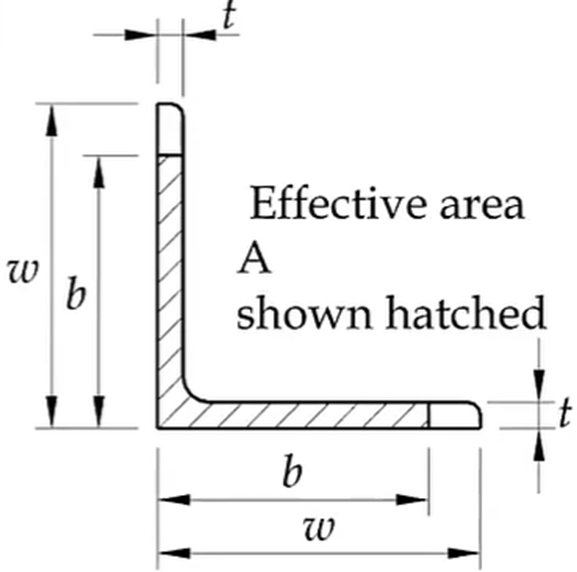
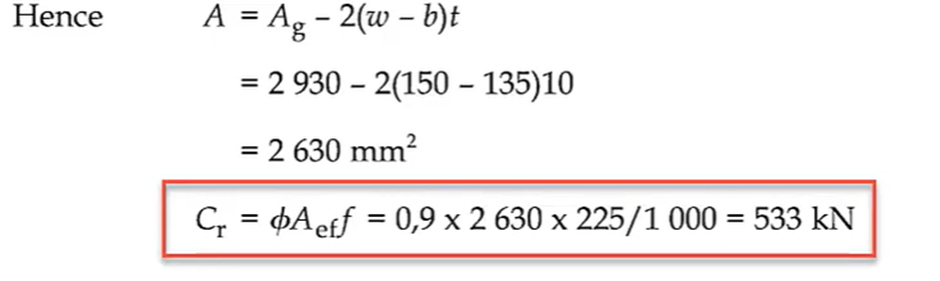
Example: 150×150×10 Equal Angle (Red Book Example 4.2)

Red Book Result: 533 kN
STRUT Result: 552 kN
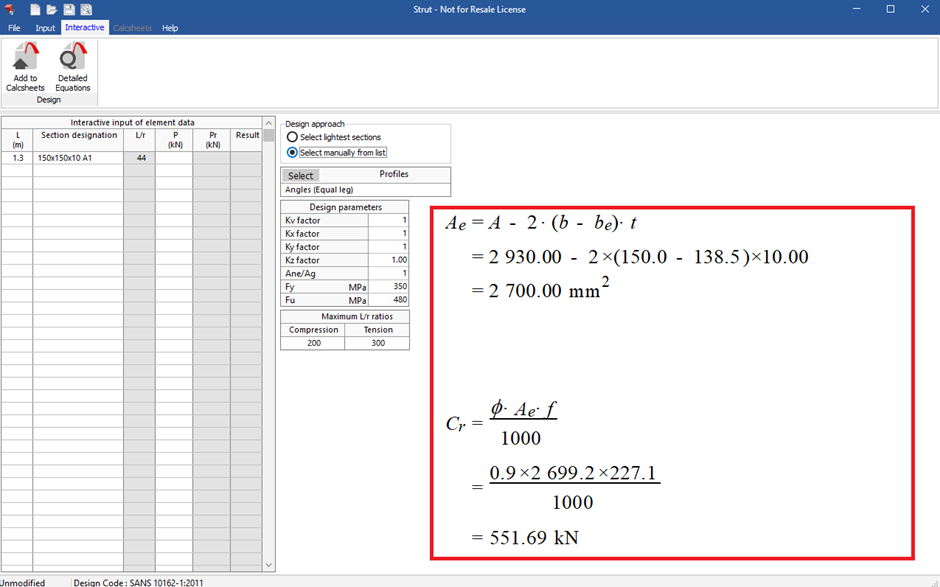
Why the difference?
- Red Book assumes warping torsion constant = 0
- the critical buckling stress is the minimum between the calculated flexural buckling stress and flexural torsional buckling stress
- for this angle the critical component is the flexural torsional buckling stress
- STRUT computes it → slightly higher critical stress

- STRUT updates effective area iteratively → stabilizes at ~2700 mm²
- Red Book uses only the first iteration (~2630 mm²)
This results in STRUT giving a more accurate (and slightly higher) compressive resistance.
Effective Area in Practice (Red Book vs PROKON Strut)
Red Book (SANS Steel Construction Handbook)
- Calculates effective area once
- Uses effective width formulae
- Computes capacity with this single reduced area
Prokon STRUT
Strut performs an iterative calculation:
- Start with the gross area.
- Reduce area to get the first effective area.
- Recompute the critical buckling stress, which changes because the area changed.
- Compute a new effective area.
- Repeat until results converge.
This typically converges in 2–3 iterations and results in a slightly higher capacity than the Red Book because:
- It more accurately accounts for the interdependence between
- effective area
- elastic critical buckling stress
- section stiffness
9. Summary
Class 4 Sections
- Slender elements → local buckling before yield
- Reduced capacity → must use effective properties
- Treated more conservatively in design
For Compression Members
- Must compute effective area or effective yield stress
- Software like Prokon STRUT uses iterative refinement
- More precise than manual (single-step) methods
